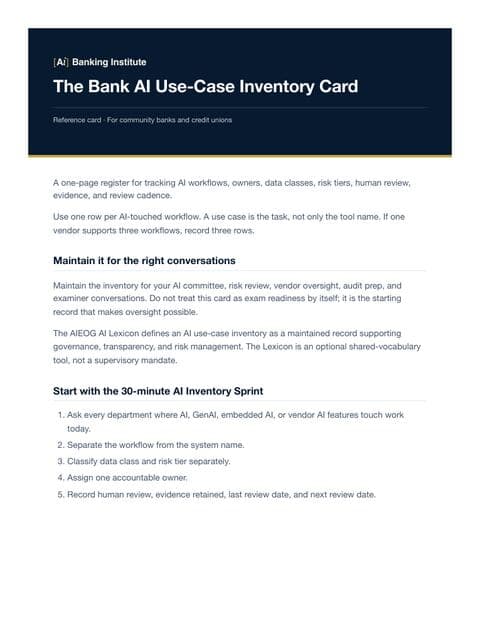
The Safe AI Use Guide
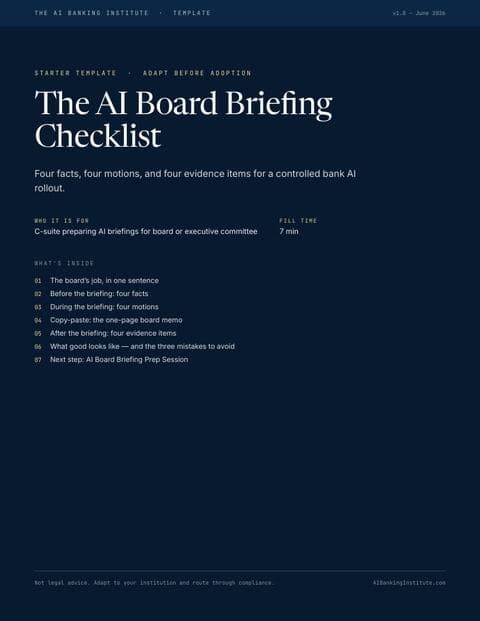
Six chapters written for community banks and credit unions. The never-paste list, private cloud vs. public model, SR 11-7 mapping, vendor scoring, shadow AI discovery, and examiner readiness. Free.
Request the guide →Resources
Short, sourced, and specific to community banks and credit unions. Every statistic on this site traces to a publication below.
Guides
Six chapters written for community banks and credit unions. The never-paste list, private cloud vs. public model, SR 11-7 mapping, vendor scoring, shadow AI discovery, and examiner readiness. Free.
Request the guide →Articles
Industry Analysis · 8 min read
The October 2025 Evident AI Index shows the top-10 global banks accelerating AI maturity 2.3× faster than the rest of the industry. Here is what that means for community banks and credit unions.
Read the analysis →
Retention · 7 min read
84% of consumers would switch financial institutions for AI-driven financial insights. 76% would switch for a better digital experience. The community bank retention story in 2026.
Read the analysis →
Risk & Governance · 10 min read
The AIEOG AI Lexicon defines six hallucination patterns that surface specifically in banking workflows. Prompt Blindness, Data Exfiltration, Recursive Logic Bias, Prompt Injection, Hallucination Drift, and Over-Reliance on Confidence. Here is what each looks like and how to defend against it.
Read the analysis →
Regulatory Guidance · 9 min read
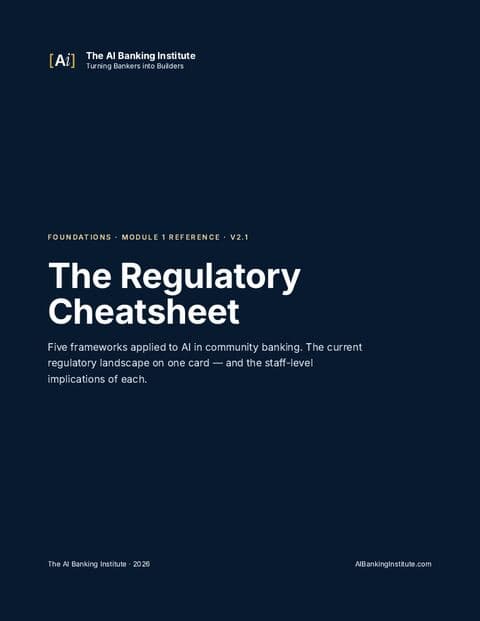
Five regulatory frameworks govern AI use at community banks today: SR 11-7, TPRM, ECOA/Reg B, BSA/AML, and the AIEOG AI Lexicon. Here is what each one actually means for your daily work — in plain language, without a law degree.
Read the analysis →
Financial Performance · 9 min read
Community bank median efficiency ratio: ~65%. Industry-wide: ~55.7% (FDIC Q4 2024). The nine-point gap is not fate — it is a measurement of where the opportunity lives. Here is where AI can move the needle, and how to calculate what it is worth to your institution.
Read the analysis →
Practitioner Guide · 8 min read
Prompting is a one-time act. A skill is a persistent, reusable, institution-grade AI instruction that executes reliably every time you need it. Here is why the distinction matters for community banks — and how to build your first one in 20 minutes.
Read the analysis →
Other publications we cite
These are the authoritative sources behind every statistic, claim, and framework in the Institute’s work. We do not host these documents — we attribute them so community bank leaders can go to the original and verify every number we cite.
Evident Insights · October 2025
Talent, Innovation, Leadership, and Transparency benchmarks across the 50 largest global banks. Source of the 2.3× maturity acceleration figure cited in the Widening AI Gap analysis.
US Treasury, FBIIC, FSSCC · February 2026
The first official cross-agency vocabulary for financial AI governance. Anchors every AI governance recommendation in this Institute’s work.
Federal Deposit Insurance Corporation · Ongoing
Source of the community bank median efficiency ratio (~65%) and industry-wide Q4 2024 figure (~55.7%) used in the ROI calculator and throughout our analysis.
Federal Reserve / OCC · 2011
The foundational model risk guidance applied to AI and generative AI systems in every governance framework we install.
Jack Henry & Associates · 2025
Source of the 66% / 57% / 55% / 48% community-bank AI attitude statistics (via Gartner and Bank Director) cited on our homepage proof strip.
Apiture (now part of CSI) · 2025
Source of the 84% / 76% / 62% consumer switching statistics cited in the Members Will Switch analysis.
Cornerstone Advisors · 2025
Department-level AI use case inventory and tool taxonomy referenced in curriculum design for the Specialist and Leader credentials.
US Government Accountability Office · May 2025
Confirms that no comprehensive AI-specific banking framework exists yet; SR 11-7, TPRM, and ECOA/Reg B apply by analogy. Shapes how we frame regulatory posture.
Coming soon
A weekly read for community-bank and credit-union leaders. Short, sourced, and free. Here’s what each issue carries: